
The Health Director for the state of Arizona tells hospitals to fully activate their emergency plans in response to surge in COVID cases.


Banner Health is Arizona’s most extensive hospital system.  They are also Arizona’s largest private employer.  In response to the COVID crisis, the company already furloughed approximately 3,oo0 employees, decreased executive’s salaries by 20 percent and created a one-time bonus pay for employees who provided direct care of COVID-19 patients during March, April, and May.

A statement released by the company yesterday informed the public they had reached capacity for ECMO treatments and was nearing capacity for their ICU beds.

Our ICUs are very busy caring for the sickest of the sick who are battling COVID-19. Since May 15, ventilated COVID-19 patients have quadrupled. Banner Health also recently reached capacity for patients receiving extracorporeal membrane oxygenation (ECMO) treatment. (2/3)

— Banner Health (@BannerHealth) June 8, 2020

The rate of new infections in Arizona has been climbing.  On Thursday, Governor Doug Ducey explained the number of new infections was related to increased testing.  He added the state was not in a crisis, as “field hospitals are available if regular hospitals run out of space.”  However, Cara Christ, the state’s health official, advised hospitals yesterday to fully activate their emergency services.  Arizona dissolved the stay at home order and, Governor Doug Ducey guided reopening on May 1 for businesses to open on May 4.  The Governor allowed sporting activities to resume on May 15 and racing on May 23 at 25% capacity.  Doctors in Arizona are not surprised about the spike of new cases in the state.
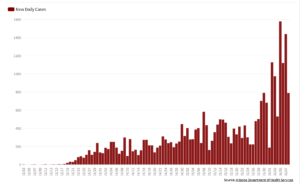
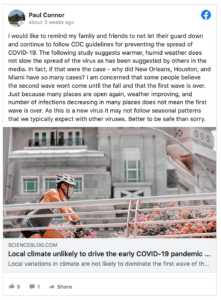
Arizona is home to many retirees, and approximately 17% of the residents are age 65 or older.  The number of COVD related deaths recently passed 1,000.  Arizona is a hot, dry state prompting the department of health to tweet about heat-related health concerns three times in June.  The hypothesis of decreased infections during warm weather suggested by some health care professionals, including CDC Director Robert Redfield, has been proven wrong. Many specialists believed warm weather was not going to decrease the rate of infections.  One of the specialists is epidemiologist Dr. George Rutherford, who warned in April to not hope for a warm-weather slump.  I also urged my family and friends in mid-May to not to let their guard down due to improving weather conditions.  Unfortunately, pandemic fatigue has set in on most Americans and my post was not well received.
If you are among higher-risk individuals who’s personal plans have eased because you believe warm weather is a deterrent to the spread of COVID-19, I recommend you reconsider your beliefs. Even if you are a person who is not at an increased risk of death due to COVID infection, the long term effects of a COVID illness are still unknown.  Be wise and follow guidelines to prevent disease.  Be proactive and protect your health. Be prepared for future medical visits and become a member on MyMedicInfo.com.

Updated 6/9/2020 at 9:40 am EST



Long term health concerns with COVID-19 infection.

covid can also cause....

Death from COVID is not the only concern for those who get the infection.  Long-lasting effects from the virus can affect the body. Damage to the lungs for those who recover from severe COVID lung infection may lead to an increased predisposition to future lung infections.  Confusion and fatigue are symptoms people may continue to experience after recovering from the acute effects of the virus.  While many who contract COVID do improve, the long term effects of this virus are still unknown.  As a clinician and as a patient, I continue to advocate for you and recommend preventing COVID exposure.

Lungs

A  virus caused me symptoms for months and may have contributed to other conditions that still bother me.   Within two years of starting my career as a PA, a colleague diagnosed me with infectious mononucleosis.  I had elevated liver enzymes, fevers, sore throat, night sweats, dehydration, and body aches.  When I saw my PA, she and her supervising doctor tested me for streptococcal throat infection, hepatitis A, B, C, tuberculosis, and HIV.  I tested negative for those infections.  A blood smear showed atypical lymphocytes.  An EBV titer blood test suggested it was the cause of my illness.  Epstein Barr is a virus that causes mild symptoms in most people.  However, some people develop more severe symptoms.  In my illness, the acute symptoms lasted three weeks.  I went on to battle postexertional exhaustion; I describe it as feeling like a rag doll.  Instead of feeling energized after a simple 15-minute walk in the park, I would experience overwhelming tiredness that lasted for days.  I knew I had to regain my strength, and it was frustrating when exercise made me feel worse.  I had no choice but to cope with chronic fatigue, which lasted more than six months.  I remember, at the time, my employer allowed me to return to work part-time for several months.  I was grateful I worked in a clinic and for a health care organization.  Had I worked for a less sympathetic employer, I could have lost my job.  It was physically not possible for me to return to full-time employment.  Chronic Fatigue Syndrome is a real condition.  My symptoms were debilitating.  To this day, some health care providers fail to recognize chronic fatigue syndrome and often tell patients that their symptoms are all in their heads.  The unbelieving clinicians cite a lack of blood tests and other organic tests as reasons to support their disbelief.  Yet, those same clinicians believe in the diagnosis of migraines even though there is a lack of blood tests and other tests to confirm migraines.  Both conditions have criteria for meeting the diagnosis and are found in populations around the globe.  Clinicians have had to be encouraged by their colleagues to believe in CFS.  Estimates suggest there are 2.5 million Americans who suffer from CFS.  People who have persistent chronic fatigue seek treatment from more than one health care provider before being diagnosed.  A  2008 survey found up to 44% of people with the diagnosis reported having to visit five or more clinicians before the determination made.  Patients also add they had to seek a different health care provider to find someone who believes them and, thus, treats their symptoms. Even if a person sees a clinician who recognizes CFS, the treatment recommendations may not be up to date.  To make matters more troubling, people with CFS battle symptoms for years before they get treatmentAnother problem with making this diagnosis is the fact that several comorbid conditions share traits with the disease.    Conditions such as fibromyalgia, IBS, and hypothyroidism have overlapping symptoms, making it difficult for even experienced clinicians to make a diagnosis.  Research for CFS continues as this condition is expensive due to costs of care and loss of productivity.

It is essential to remember some viral infections are associated with long term risks.   After an EBV diagnosis, a person has an increased risk of developing lymphoma.  Varicella virus infections can return later in life, causing shingles that may present with a variety of symptoms and possibly severe consequences.

The number of new COVID infections reached all-time highs last week in the states of Arizona, Florida, North Carolina, Oregon, and South Carolina.  As the country reopens, the virus spreads, and new infections abound.  Sign up for member-only benefits, including:

Prepare for your next medical visit.

Improve communication between you and your health care providers.

Comprehensive guidelines for at-risk individuals to prevent infection.

Have questions about the service or membership?   Contact me, and I will answer your questions about membership.

Stay informed and stay well.

Updated on 6/6/2020 at 2:07 pm EST

National and international copyrights protect this article and MyMedicInfo.com.  Using a web link to reference the post is acceptable.  Acknowledgment of the author appreciated.

Why I Created MyMedicInfo

I’ve been a physician assistant for 25 years.  I have worked in family medicine, internal medicine, addiction medicine, and orthopedic surgery.  I have seen patients struggle with remembering the specific names or doses of their medication.  I know the questions your health care providers ask when you see them in the clinic, urgent care, emergency room, hospital, and ambulances.  I’ve seen patients in agony trying to answer my questions when they had migraines, chest pain, abdominal pain, or shortness of breath.

When the encouragement from changing from paper charts to electronic medical records developed, it was sold to us as ways to improve patient care.  There would be fewer medical errors, better communication, and improved outcomes for patients.  Over the years, the government enforced electronic medical records by reducing medicare reimbursements year after year on those hospitals and clinicians who did not use electronic medical records.

Your medical information is encrypted and protected on those web servers.  However, all of your medical treatments and information are probably on different systems.  If you have a primary care physician, a cardiologist, and an endocrinologist, the odds that they are all on the same electronic medical system is low.  To get access to all of that data is cumbersome and often complicated.  MyMedicInfo simplifies access to your medical history by using Trusona for user authentication and no password to remember.   Plus, you control your medical information—highly sensitive and confidential information you can omit.  For example, if you have a history of a sexually transmitted infection, simply skip that information.  An emergency room physician or paramedic is more interested in your allergies, medications, and what diagnosed conditions you have.  MyMedicInfo will enhance your medical care.

As a health care provider who has worked in a variety of clinics and environments, I can get frustrated with the technology intended to make things better.  I’ve worked at a hospital where the health care providers had to take classes to use the hospital’s electronic medical records.  Health care electronic systems should not be so complicated that you have to take classes to navigate through them.

I developed this website to keep your information secure.  It has three levels of security.  First, it has the highest level of SSL encryption available.  A firewall is frequently scanning and preventing unauthorized access: Additionally, it uses a password-free two-factor authentication login to verify your identity.  The service does not allow a user to upload files to protect the website.  I know that with any medical care, you need to trust the people involved to protect your information and promote your health. 

You probably have received medical treatment from a physician assistant.  You know they are highly skilled, knowledgable practitioners.  I am proud of my career and my chosen profession.  Physician Assistants are sometimes called patient advocates.  We have a reputation for explaining complex medical terms in a way that is easier to understand.  We have a reputation of spending more time with patients, especially when doctors are pressured for their time.  Physician Assistants tend to be thorough in their evaluations and have a high rate of patient satisfaction.

I’ve included a link to a video clip of one of my recent discussions on the COVID pandemic. Watch it if you want to learn more about me.  I want to earn your business.  I wish you wellness and continued excellence in medical care as you interact with professionals in the future.

Local reports show devastating impact of COVID 19 in the United States

Reports from around the country: those with comments after the state are noteworthy reads

Alabama

Alaska

Arizona Overdose from self medicating.

Arkansas

California

Colorado

Connecticut One party in early March finds half of the guests got infected.

Delaware

Florida Doctors are starting to see a high number of people presenting to emergency rooms in south east counties in the state.

Georgia

Hawaii

Idaho Emergency room physician shares his thoughts.

Illinois First known COVID-19-related infant death in US

Indiana

Iowa

Kansas

Kentucky Amazon warehouse performs deep cleaning.

Louisianna High jump in deaths overnight.

Maine

Massachusetts

Maryland Majority of cases in Maryland are under the age of 65.

Michigan

Minnesota Rural hospitals attempt to prepare for COVID patients.

Mississippi

Missouri

Montana 6000 workers file for unemployment.

Nebraska

Nevada

New Hampshire

New Jersey Timeline of the outbreak.

New Mexico Air Force base has 3 confirmed cases.

New York. Emergency Room doctor states 90% of those presenting to the emergency room have COVID symptoms.

North Carolina

North Dakota

Ohio In one county, half of the cases are in people aged 20-39.

Oklahoma

Oregon

Pennsylvania

Rhode Island

South Carolina

South Dakota

Tennessee Second death from COVID in Tennessee.

Texas Former Texas A&M guard David Edwards dies from coronavirus.

Utah

Vermont

Virginia

Washington Husband and wife die 2 days apart, both from coronavirus-19

West Virginia Trouble getting tested in West Virginia explains why it was the last state in the country to confirm a positive result.

Wisconsin

Wyoming Trouble getting tested despite symptoms.

Updated 3/28/2020 at 10:28 pm EST